


AI's impact on modern data governance strategies
NOV. 4, 2026
6 Min Read
AI turns data governance from a policy function that reviews reports into an enforcement layer every agent call passes through.
When enterprise data governance only had to protect dashboards, a quarterly access review and a policy library could keep up. Agents and generative tools now read data, combine it and act on it in seconds, and many do so without a person checking the result. Reported AI incidents reached a record 362 in 2025, according to Stanford's 2026 AI Index. Each new agent adds another path to data that a quarterly review will never see.
The governance programs that hold up put their rules where AI reads data. That means the catalog, the permission system and the audit log. A document on a shared drive can describe a rule, but it can't enforce one.
Key Takeaways
- 1. AI agents are a new kind of data consumer, so governance has to control what each agent reads, writes and records on every call.
- 2. Rules enforced in the catalog through grants, tags and masks hold for every agent, while rules kept only in policy documents do not.
- 3. One accountable leader, named table owners and reviewed MCP tools close the gaps that appear when agent risk crosses team lines.
How AI changes what data governance has to control
AI changes data governance by adding a new kind of data consumer. An agent queries tables, retrieves documents and calls tools at machine speed, under an identity that may serve hundreds of users. Governance now has to control what each agent can read, what it can write and how every action is recorded.
"A document on a shared drive can describe a rule, but it can't enforce one."
Take a wealth management firm that added an advisor assistant. Before, an advisor opened a client file and a log recorded the view. Now the assistant reads holdings, meeting notes and market research in one request to draft a summary. The governance question shifts from "who opened this file" to "what did the agent combine, and was each source allowed for this client."
Why policy documents stopped being enough for AI
Policy documents describe rules, but agents don't read them. A rule that lives only in a PDF won't stop a query at runtime. AI data governance works when each rule is enforced in the systems the agent uses, so a violation is blocked before it happens.
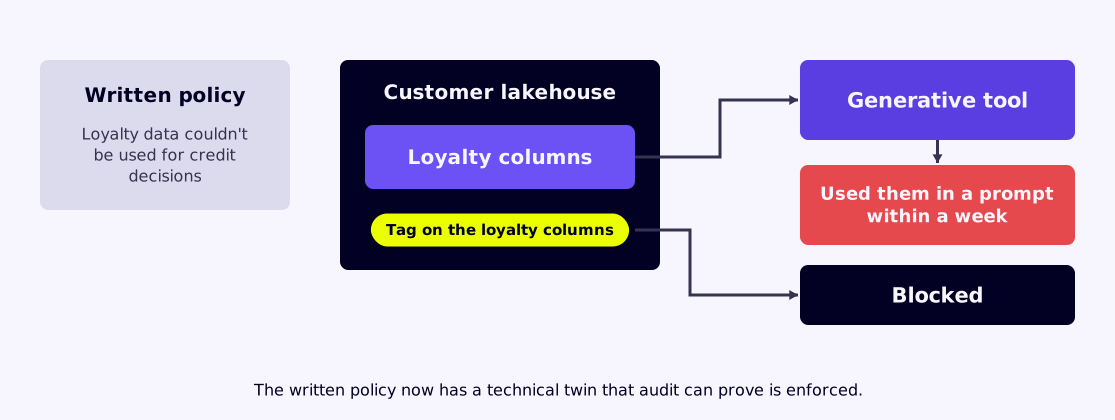
A retailer had a written policy that loyalty data couldn't be used for credit decisions. When a team connected a generative tool to the customer lakehouse, nothing in the catalog marked loyalty columns as restricted. The tool used them in a prompt within a week.
The fix wasn't a new policy. It was a tag on the loyalty columns and a rule that blocked tagged data from that workload. The written policy now has a technical twin, and audit can prove it's enforced.
Governing data access for AI agents at the catalog layer
Govern agent access at the catalog layer, where grants, tags, row filters and column masks already live. When an agent queries through the catalog, it inherits every rule your data team has written. Rules applied at the prompt or application layer break as soon as someone adds a new tool.
Governed business definitions are the context layer most agents are missing. For governance, context means owners, tags and definitions that travel with the data to every agent that reads it.
A hospital network applies this by tagging protected health information at the column level. Any agent querying through the catalog sees masked values unless its identity holds clinical access.
The tradeoff is upfront work. Tagging and ownership take effort before the first agent ships, but that effort is reused by every agent after it.
How MCP permissions extend governance to agent tools
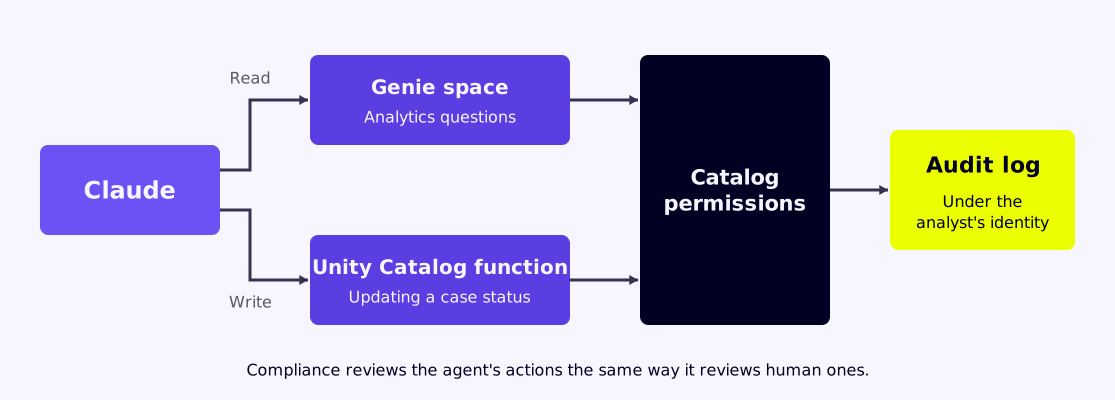
The Model Context Protocol (MCP) gives agents a standard way to call tools, so MCP servers become governance checkpoints. Each server should run under a known identity, expose only reviewed tools and pass every call through the same catalog permissions as any other query.
A bank connecting Claude to its lakehouse might expose a Genie space for analytics questions and one Unity Catalog function for updating a case status. Claude can read what the analyst can read and write only through that single function. Every call lands in the audit log under the analyst's identity, so compliance reviews the agent's actions the same way it reviews human ones.
"Tagging and ownership take effort before the first agent ships, but that effort is reused by every agent after it."
The risk sits in servers nobody registered. A developer who points an agent at a self-hosted MCP server with a broad service account creates a path around the catalog. Keep a list of approved servers, and block the rest at the network edge.
What an AI data governance framework needs in production
An AI data governance framework in production needs enforceable controls as well as principles. It should name owners, apply access at the catalog, tag sensitive data, record every agent action and test the rules regularly. Each control should map to a system that enforces it.
Here's how the main controls compare when governance moves from reports to agents.
| Control | Governance built for reports | Governance built for AI in production |
|---|---|---|
| Access | Granted to people by role and reviewed every quarter | Granted to each agent identity and checked on every call |
| Sensitive data | Listed in a policy and handled by trained analysts | Tagged in the catalog and masked automatically for agents |
| Definitions | Kept in a glossary that people look up when needed | Stored with the data so every model reads the same meaning |
| Tool use | Not a concern because reports don't take actions | Limited to reviewed MCP tools and functions with named owners |
| Audit | Records who opened a report and when | Records what the agent read, combined and changed, and why |
Notice that none of these replace the old controls. They move the same intent into systems an agent can't bypass.
Who owns AI data governance across the enterprise?
The Chief Data Officer should own AI data governance, with security and legal as partners and each domain naming its data owners. One accountable leader matters because agent risk crosses team lines. A split model leaves gaps where the data team assumes security covered it, and security assumes the reverse.
Culture matters as much as structure. Among organizations that ignore the cultural side of data governance, Gartner predicts 60% will fail to govern AI successfully by 2027. An insurer that asks claims leaders to own claims data, rather than handing it to a central team, gets faster answers on what agents may use.
Ownership works best when it's specific. A working model usually assigns five roles.
- The Chief Data Officer sets the governance standard and owns the result
- Domain leaders name an owner for each critical table
- Security owns agent identities and the audit review
- Legal decides which data each AI workload may use
- Platform teams enforce those decisions in the catalog
Review the map every quarter, since agents gain new data sources faster than org charts change.
What governance looks like when AI runs every day
When AI runs every day, governance looks routine. New agents start from tagged, owned data. Permissions are granted to identities, tools are reviewed before release and audit logs answer questions in minutes. The program spends its time on new use cases instead of cleaning up after old ones.
Lumenalta® works this way on Databricks and Claude delivery, with teams of senior specialists and agents building catalog enforcement, agent access controls and MCP permissions into the same release. Decision traceability and compliance controls are embedded from the start.
When data governance and AI share one delivery plan, governance isn't heavier. It's closer to the data, and it's tested like any other production system.
Table of contents
- How AI changes what data governance has to control
- Why policy documents stopped being enough for AI
- Governing data access for AI agents at the catalog layer
- How MCP permissions extend governance to agent tools
- What an AI data governance framework needs in production
- Who owns AI data governance across the enterprise?
- What governance looks like when AI runs every day
Common questions about data governance
How does AI improve data governance in enterprises?
What are the main benefits of AI in data governance?
What challenges do businesses face with AI-driven data governance?
What are the future trends in AI and data governance?
Why is data lineage important in AI-driven data governance?
See how AI data governance improves AI accuracy and controls spend.