


How to build a successful AI strategy for long-term success
NOV. 3, 2026
6 Min Read
A successful AI strategy ships its first production use case within 12 months, on data you already govern.
Most strategy documents written in 2024 set a three-year vision, listed dozens of use cases and left the data question for later. That order is backward. Gartner predicts organizations will abandon 60% of AI projects unsupported by AI-ready data through 2026. The vision rarely fails on its own. The missing sequence does.
Three questions, answered in this order, turn AI in business strategy into work that ships.
- Which data can a model or agent safely read today?
- Which use case will pay back first?
- Who owns the result once it's live?
You'll get further with a plan that answers these in one year than with one that promises everything in three.
Key Takeaways
- 1. An AI strategy proves itself by shipping its first production use case inside 12 months, on data that already has owners and access rules.
- 2. Rank use cases on business value and data readiness at the same time, so early releases build the foundation that later use cases depend on.
- 3. Keep the governed data layer independent of any single model, so a model change becomes a testing task instead of a rebuild.
What an enterprise AI strategy has to include
An enterprise AI strategy needs five elements, and each one is where AI and business strategy meet in practice. Every element names a date, an owner or a rule, so the plan fits on two pages. Anything beyond these five belongs in a backlog, where it can wait without slowing the first release.
Here is how each element reads in a plan your board can check.
- A governed data foundation with owners, definitions and access rules for the tables your first use cases need
- A ranked list of no more than five use cases, scored on value and data readiness
- A 12-month sequence with a production release date for the first use case
- A model and partner choice made for each use case, with a clear exit path
- One accountable owner per use case who reports the business result every quarter
A regional insurer that writes those five lines on two pages has a strategy. One with a long vision deck and no release date has a reading list. The gap shows up at the first quarterly review, when the board asks what shipped and nobody can point to a live system.
Why the 2024 strategy playbook stopped matching agentic AI
The 2024 playbook assumed AI would answer questions. Agentic AI takes actions, such as updating a record, sending a request or calling another system. That shift moves risk from the answer to the action, so a strategy needs permissions, audit trails and cost limits planned before the first agent goes live.
Escalating costs, unclear business value and inadequate risk controls will push over 40% of agentic AI projects into cancellation by the end of 2027, according to Gartner. Each of those causes traces back to a plan that never said who approves an agent's action or what a run should cost. A claims team that lets an agent draft settlement letters needs a spend ceiling and a human sign-off step written down first. Without them, the pilot stops at the first audit question, and the budget goes with it.
Start your AI strategy from the data you already govern
Start with the data that already has an owner, a definition and access rules. A first use case built on governed tables reaches production faster because legal, security and finance have already agreed what the data means and who can see it. Ungoverned data turns every model question into another meeting.
A model's results depend less on its intelligence than on the context it can read. For your strategy, context means the business definitions, permissions and lineage a model or agent can read before it acts.
A wealth manager planning an advisor assistant might find client holdings well governed and meeting notes scattered across shared drives. The holdings data supports a first release now. The notes need owners and retention rules before any agent reads them, so they move to the second wave.
The tradeoff is scope. Starting from governed data narrows the first use case, and some executives will read that as timid. A narrow release that works earns the budget for the data work the bigger use cases need.
How to prioritize AI use cases for the first year
Prioritize AI use cases on two scores, business value and data readiness, then pick the ones that rank high on both. A use case with large value and unready data belongs in year two. A modest use case on ready data often belongs first, because it proves the delivery path.
Here is how a COO might sort a typical shortlist once both scores are in.
"A narrow release that works earns the budget for the data work the bigger use cases need."
| Use case | Value to the business | Data readiness today | Where it belongs in the plan |
|---|---|---|---|
| Invoice exception handling | Cuts manual review time for a finance team that already tracks it | Vendor and invoice tables have owners and definitions | First release, inside two quarters |
| Customer service summaries | Shortens handle time on every call | Call transcripts exist but lack retention rules | Second wave, once retention rules are set |
| Inventory forecasting | Reduces stock write-offs across regions | Sales history is governed while store data is partial | First wave for the governed regions only |
| Contract review agent | Speeds legal review of standard agreements | Contracts sit in shared drives with no tags | Year two, after tagging and access rules |
| Sales pipeline scoring | Helps reps focus on deals likely to close | Pipeline fields differ across business units | Year two, after shared definitions are agreed |
The ranking rewards readiness as much as value, and that's deliberate. Each early release builds the governed data and the delivery habits that make later, larger use cases cheaper to ship.
Sequencing a 12-month roadmap from foundation to production
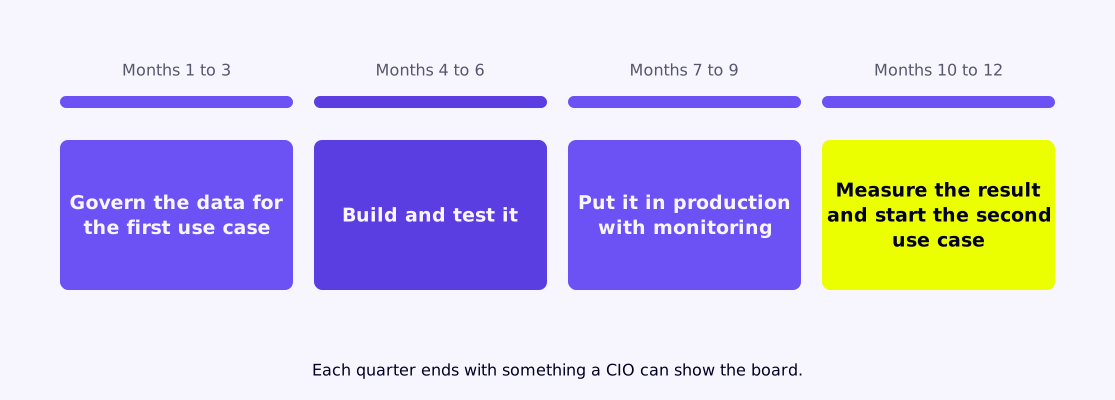
A 12-month AI strategy roadmap runs in four quarters. Months 1 to 3 govern the data for the first use case. Months 4 to 6 build and test it. Months 7 to 9 put it in production with monitoring. Months 10 to 12 measure the result and start the second use case.
Picture a manufacturer starting with maintenance work orders. The first quarter assigns owners to asset and work order tables and sets access rules. The second builds an agent that drafts work orders from sensor alerts, tested against last year's records. The third releases it to two plants, with a technician approving each order. The fourth compares downtime against the prior year and opens the next use case on the same foundation. Each quarter ends with something a CIO can show the board, which keeps the roadmap funded when priorities shift.
How model partner choices shape your AI strategy
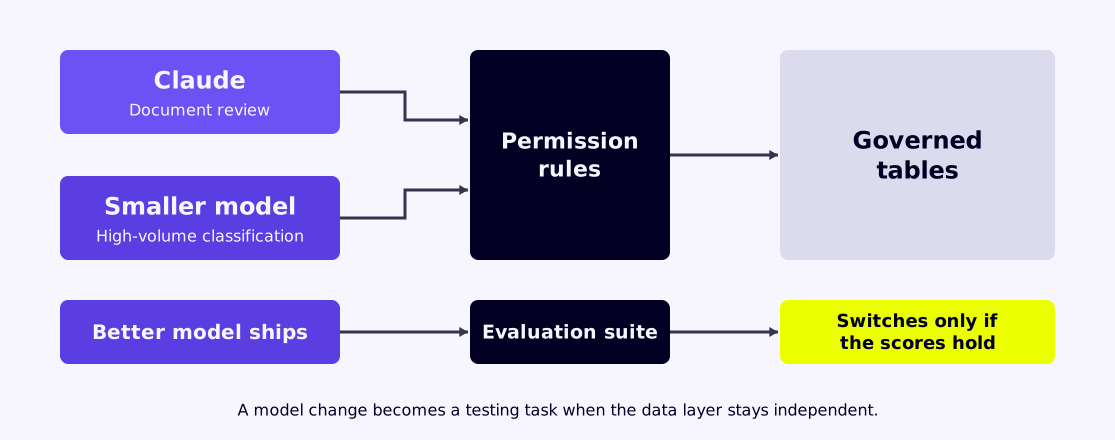
Choose models per use case, and keep the data layer independent of any one model. Your governed data, permissions and evaluation tests should outlast the model you start with. That way, a model change becomes a configuration and testing task instead of a rebuild of the whole program.
"Each quarter ends with something a CIO can show the board, which keeps the roadmap funded when priorities shift."
A bank might run document review on Claude for its long-context reasoning and keep a smaller model for high-volume classification. Both read the same governed tables through the same permission rules. When a better model ships, the team reruns its evaluation suite and switches only if the scores hold.
Lumenalta®works this way as an Anthropic Select Partner and a certified Databricks Delivery Partner (DPP). Teams of senior specialists and agents build the governed data layer first, then connect models to it, so the model choice stays open as the options improve.
What long-term success looks like after the first year
Long-term success looks like a second and third use case shipping faster than the first, on the same governed data. The first year builds the foundation, the delivery habit and the ownership model. Every later year spends less on setup and more on results, which is the compounding an AI strategy should promise.
You'll know it's working when business units bring use cases to the data team instead of the other way around. A CFO who has seen invoice exceptions drop will ask for the same approach on collections. That request is the clearest sign the strategy has taken hold.
It's tempting to treat strategy as a document you finish. The better habit is a quarterly review that reranks use cases, retires what didn't pay back and funds what did. The plan stays short because it keeps shipping.
Lumenalta® builds that discipline into delivery, with decision traceability and compliance controls embedded from the first release. A strategy run that way doesn't need to promise long-term success. It earns it one shipped use case at a time.
Table of contents
- What an enterprise AI strategy has to include
- Why the 2024 strategy playbook stopped matching agentic AI
- Start your AI strategy from the data you already govern
- How to prioritize AI use cases for the first year
- Sequencing a 12-month roadmap from foundation to production
- How model partner choices shape your AI strategy
- What long-term success looks like after the first year
Common questions about AI strategy
What is an AI strategy, and why is it important?
How can AI be used to enhance business decision-making?
What role does data play in developing an AI strategy?
What industries benefit most from AI strategies?
How do ethical considerations impact AI implementation?
See how an AI strategy built on governed data improves AI accuracy and controls spend.